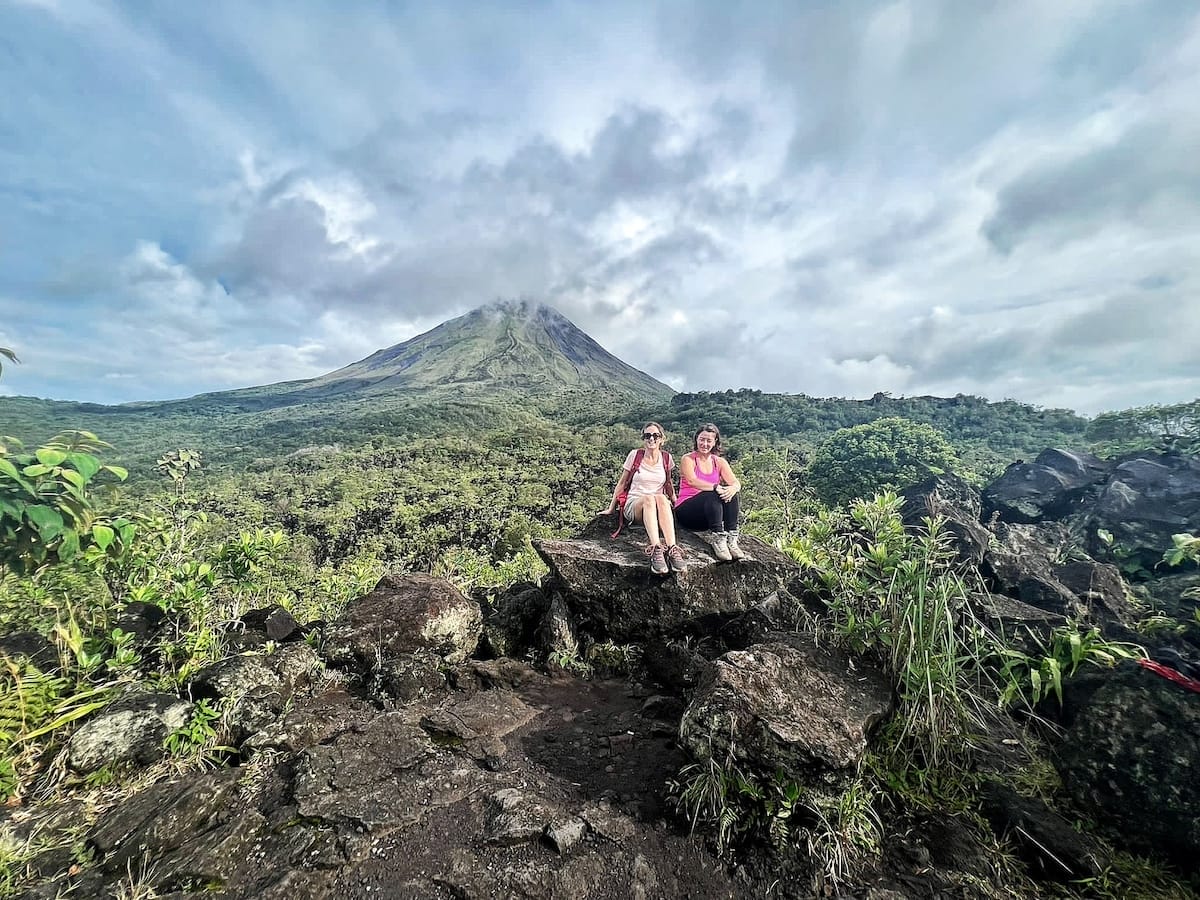
There are many things to do in La Fortuna, Costa Rica. My sister and I got to spend a few days there during our most recent Costa Rica trip, and we wished we could have stayed more!
La Fortuna is a must-see place in Costa Rica. It’s located at the foot of Arenal Volcano, which is now dormant (more about this in a bit), and home to numerous hot springs, a beautiful lake, rushing rivers and a lush forest.
Located in the northern part of the country, La Fortuna is small and cozy town. There’s a central square with a church and, next to it, a garden. You will find many stores where you can buy souvenirs; some nice restaurants, bars and clubs where you can listen to live music and dance, and tour companies that can help you plan the best activities in La Fortuna you’d like to try.
In 1968 the Arenal Volcano, after having been dormant for nearly 400 years, erupted burying the neighboring towns, except La Fortuna. That year marked La Fortuna tourism boom. Today, large numbers of tourists from all over the world continue to visit La Fortuna, despite the fact that the volcano has not been active since 2010.
Curious to find out more? Continue reading, as we have selected the best things to do in La Fortuna, all tried and tested and with lots of recommendations to help you make the most of this lovely place.

Best Things To Do In La Fortuna
Admire Arenal Volcano National Park
Needless to say, visiting Arenal Volcano is among the top 10 things to do in La Fortuna. Arenal Volcano is clearly visible from La Fortuna, when clouds don’t cover its top. However, there are several parks and private reserves that allow you to get close to and walk on the lava flows.
One thing many don’t know is that Arenal Volcano National Park – one of the most famous national parks in Costa Rica – has two volcanoes: Arenal and Chato.
Whereas Arenal is one of the most active volcano in Costa Rica, Chato Volcano has been inactive for nearly 3.500 years and now its crater contains a beautiful lagoon.
On 29th July 1968 Arenal Volcano erupted and its lava destroyed three villages, Pueblo Nuevo, Tabacón and San Luis, killing 87 people and changing the topography of the area. However, since 2010 Arenal Volcano activity has decrease. Mind you though, this is very much an active volcano, even though it is now dormant.
There are plenty of things to do in Arenal Volcano National Park. Even if you won’t see ash rising from its top or the lava flowing down its sides, you can walk on lava fields from previous eruptions, passing through the secondary forest looking for wild animals like howler monkeys and white-faced monkeys, tapirs, deer and different kinds of birds.
With so many things to do in Arenal, I recommend joining a tour that combines several activities such as a volcano hike, a safari float, hanging bridges and hot springs.
I recommend this La Fortuna: Waterfall, Arenal Volcano and Hot Springs Tour – This highly rated guided tour of Arenal Volcano National Park includes a hike on the 1968 lava fields, and it also visits La Fortuna Waterfalls, the Indigenous Maleku Community, and one of the nicest hot springs in La Fortuna.
Another highly rated option that combines some of the best activities in La Fortuna is this La Fortuna Waterfall, Volcano and Hanging Bridges Combo which also includes hiking in Arenal Volcano National Park.

Explore Arenal 1968 Reserve
Right next to Arenal Volcano National Park, Arenal 1968 Reserve is a private reserve takes its name to the eruption in 1968.
Hiking is one of the best things to do in Arenal, and here you can walk two hiking trails on lava fields for a total of around 9.4 kilometers (5.8 miles).
The first one is the Lava flow 1968 Trail or Sendero Colada 1968 in Spanish.It is a 4,7 kilometers (3 miles) trail that is moderate to difficult. It goes first into the rain forest and then climbs up on lava fields. The trail gets steep but, once you reach the top, you’ll be rewarded by an amazing view of the Arenal Volcano.
The Forest 1968 Trail (Sendero Bosque 1968 in Spanish) is around the same length. It is a circular route and you’ll pass next to Arenal Lake too.
If you are a keen hiker, you can easily hike both trails on the same day; but if you are short of time, I recommend opting for the Lava Trail.
Arenal 1968 Reserve is open every day from 08:00 am to 05:00 pm. You can hike the trails independently, but personal advice is to hire a guide or join a guided tour because it’s interesting to know more about how the volcano was formed, the history of the eruption in 1968 and the local flora and fauna.
This Arenal 1968 guided hike offers two daily departures. You will be picked up from your accommodation in La Fortuna and have a guide for the duration of the experience, which lasts four hours in total.
I also recommend to tackle the hikes early in the morning because temperatures get higher in the middle of the day, and because in the afternoon there are higher chances of rain and you might find the top of the volcano covered by clouds.
At the entrance of the reserve you will find walking sticks which might be very useful during the hike. You should also carry water, snacks, sunscreen, a hat and, during the rainy season, a rain jacket or poncho and a waterproof cover for your backpack. Hiking shoes are a must for this hike!

Hike to Mirador El Silencio
This was one of our favorite things to do in La Fortuna, so we highly recommend it!
The private reserve El Silencio is located about 10 kilometers (6.2 miles) from La Fortuna. Inside the reserve, there are six trails that go inside the primary and secondary forest and lead through lava flows to two beautiful viewpoints from where you can admire the Arenal Volcano.
The level of the trails varies from easy to moderate difficulty. You can grab a map at the entrance and get all the information you need to decide what is the best trail for you.
We did the Lava Fields Trail, that starts next to the parking area and goes into the forest and then on the lava fields and large volcanic rocks. We were very lucky because the sky was clear and we could admire the Arenal Volcano in all its beauty.
If you don’t have a car, you can join this guided tour of El Silencio Reserve that includes transportation from La Fortuna. The tour lasts 3.5 hours which is just the right amount of time to make the most of the area.

Check out La Fortuna Waterfall
Visiting La Fortuna Waterfall is definitely one of the top things to do in La Fortuna.
La Fortuna Waterfall is located inside Arenal Volcano National Park. In a natural scenery of a wild and lush forest this spectacular waterfall plummets for 70 meters (almost 230 feet) into a beautiful natural pool below.
Around 200 meters (0.1 mile) from the entrance there is a viewpoint, that is wheelchair accessible too, from where you can admire the waterfall from a distance and the surrounding lash forest landscape. This is one of the best views of the waterfall and of the entire area and you can get wonderful photos from here.
Next to the viewpoint there is the Orchid Garden, which has a huge variety of this flower. That’s also where you will find the steep trail to the waterfall. More than 500 stairs will lead you to the natural pool.
At the beginning the trail is paved but then the stairs change to wood, steel, rocks and mud. It usually takes 15 minutes to go down and half an hour to climb up the stairs. You may want to bring hiking poles to help you going down. Anyways – there are handrails and benches to catch your breath. Take your time, enjoy nature and try to spot wild animals on your way.
At the bottom of the stairs, after the bridge, there is a rest area and another viewing platform: you will be rewarded with an incredible view. The trail ends where you will find a beautiful series of natural pools where you can have a refreshing swim.
Swimming right at the base of the fall is hard, due to the strong pressure of the water, so you may prefer swimming in one of the pools at the left. The water is cold, but you might enjoy even more after the hike and the humid heat.
Since it is one of the best things to do in La Fortuna, La Fortuna Waterfall can get a bit crowded in the peak season, so try to get there as soon as it opens at 7:00 am. You may even want to consider getting tickets to La Fortuna Waterfall in advance.
If you don’t have a car, you can opt for this La Fortuna: Waterfall, Arenal Volcano and Hot Springs Tour. It goes to Arenal Volcano National Park, La Fortuna Waterfalls, the Indigenous Maleku Community, and one of the nicest hot springs in La Fortuna.
Once you are in the La Fortuna Waterfall area, you will find toilets, changing rooms with showers and lockers, a souvenir shop and a restaurant.
For your visit, I recommend wearing hiking shoes. You will also need to bring a swimsuit if you wish to swim in the natural pools, a change of clothes, sunblock and mosquito repellent, water and snacks. You should also bring a rain jacket, just in case!
My post The Best Waterfalls In Costa Rica highlights other unique waterfalls you may want to visit during your trip.

Walk the Mistico Arenal Hanging Bridges
Would you like to walk on a canopy of trees and be on the same level of monkeys and birds?
If your answer is yes, then walking the hanging bridges is what to do in La Fortuna.
Not far from La Fortuna, Mistico Hanging Bridges Park stretches for 250 hectares of lush and thick rainforest, which has different layers: treetops, underbrush and forest floor.
Here, you’ll have the opportunity to observe a high density of biodiversity: wildlife like monkeys, reptiles, peccary, coati; different species of tropical birds like hummingbirds; spiders, and other insects.
The main trail inside the Mistico Arenal Hanging Bridges Park is 3,2 km (about 2 miles) long. It makes a loop and crosses 16 hanging bridges. The path is easy, even if it gets a little steep – and there are benches along the way where you can rest.
Every hanging bridge is different from the other in terms of length and height. The highest is 55 meters (180.4 feet) above the ground and the longest is 97 meters (318.2 feet). From the first bridge, when the sky is clear, there’s a beautiful view of Arenal Volcano.
The bridges do sway a little, especially when you are in the middle, but they are safe. It’s not scary: the bridges have railings on both sites.
Along the trail, there are panels with useful information about the forest such as its lifecycle, wildlife, details about trees and flowers. If you opt for a self-guided tour, they might be very useful.
One thing you may be happy to know is that the park is disabled-friendly: there is a non-slip concrete trail of 1.5 kilometers (0.9 miles) with a slight slope for wheelchairs. Any people with mobility issues can rent a cart to explore the park.
It takes about 2.5 hours to walk the main trail at Mistico, so try to be there early to make the most of it and avoid the crowds. You should also try to get tickets in advance on the official website – you will have to select a time-slot for your visit.
If you want to spot wild animals, you’d better try to avoid the crowds: coming early in the morning, not talking loudly and hiring a guide or joining a group are my recommendations. A professional guide has a trained eye to spot animals camouflaged in the nature. You can join one of the guided tours offered directly by the park.
Otherwise, if you want to hit many activities in La Fortuna in one day, I recommend this La Fortuna Waterfall, Volcano and Hanging Bridges Combo that goes to Mistico Hanging Bridges and also includes hiking in Arenal Volcano National Park.
If you don’t have a car, Mistico Hanging Bridges Park can provide transportation from and to many hotels for an additional fee – you can select where you want to be picked up from while purchasing your ticket.
If you go by car, there is a car park next to the entrance. Inside the park there are restrooms, a restaurant, a gift shop and the hummingbird garden.

Choose your sports or relax on a boat tour at Lake Arenal
If you like water sports and you want a different location from the Caribbean or Pacific beaches in Costa Rica, Lake Arenal offers some of the most fun activities in La Fortuna!
Just 15 minutes drive from La Fortuna, at the base of Arenal Volcano, Lake Arenal is the country’s largest lake. It was originally much smaller than it is today, in fact in 1979 it was enlarged to three times its original size because of the construction of a hydroelectric dam.
Lake Arenal and its dam are nowadays one of the main producers of hydroelectric energy of the country (35/40%). But the lake is also important because its wetland created an ecosystem, together with the surrounding forest, where wild animals and several species of birds live.
The lake offers amazing landscapes, an incredible view of Arenal Volcano, the opportunity to spot birds and animals and many “pura vida” activities in La Fortuna – such as windsurfing, kitesurfing, kayaking, fishing and much more.
I must admit that before going, I didn’t know that Lake Arenal is famous for windsurfing. In particular from November to April the wind is constant and strong and the number of windsurfers increase. For the same reason you can enjoy kitesurfing here.
Fishing is quite popular too at Lake Arenal. The most common species of fish that live in the lake are rainbow bass and machaca fish. These fishes with sharp teeth are hard to catch, making the fishing a pure and fun challenge.
Sunrise and sunset are the best time to go fishing in Lake Arenal. Even if won’t catch anything, you will enjoy the beauty of this place with this magic sunlight.
Other things to do in Lake Arenal include biking or horseback riding around the lake, or kayaking or stand up paddle boarding – you can enquire locally for guided tours during which you can also enjoy birdwatching, or to rent your equipment.
Finally, you could opt for a boat tour of Lake Arenal such as this one that includes transportation from La Fortuna. During the tour you can simply relax and listen to the guide’s explanation about the history of the lake and its flora and fauna. You can see birds, mammals and reptiles around the lake and take your best shot of the Arenal Volcano reflecting on the lake water.
Lake Arenal is easy to reach from La Fortuna by car. If you don’t have a car and don’t want to join a guided tour, you can take a taxi or hope on a bus to Tilarán Town. You will close to the National Park but you need to walk to reach the public access to Arenal Lake.


Go whitewater rafting
Rafting is one of the unmissable things to do in La Fortuna for anyone looking for an adrenaline fix.
Not far from La Fortuna, there are rivers where you can enjoy rafting of different levels of difficulty: Balsa River, Sarapiqui River and Pacuare River. The level of the rapid depends on the river, the section of the river and the amount of rain that has fallen in the days prior to when you go rafting.
If you are a beginner or just want to have fun but are not a dare devil like we are, you should go for Class II and III white water rapids. If you want to challenge yourself and have an adrenaline rush, go for Class IV and V rapids.
Whatever is the class of rapids, you’ll start your tour with a short training to learn the different paddling techniques, safety signals and positions. For your own safety, you will wear a lifejacket and a helmet and receive a paddle. On every rubber dinghy there’s a guide that gives instruction on what to do to face the rapids.
On the way, you’ll be pleased by the beauty of the lush forest and the chance to spot wild animals.


We opted to raft on the Sarapiquì River with Arenal Rafting and had a blast. We stopped to climb a cliff and jumped in the water from there; we fell in the water and our team-mates had to lift us back on the raft (that training was useful!). It was nothing short of amazing!
White water rafting tours last all day. You will be picked up from your hotel and drive to the starting point, where you will get all the necessary safety equipment and paddles. During the tour, a professional photographer from the team will be traveling with you and snap photos at key moments.
At the end of the tour, you’ll be offered a towel, a bottle of water or a juice and some seasonal fruit to snack on. Once back in La Fortuna, a traditional lunch is included.
During the meal, the photos taken during the rafting expedition will be displayed on a big screen and you can buy them for a small additional fee.
Rafting is one of the most expensive things to do in La Fortuna, but it’s so worth it!
We opted for this class III and IV rafts river rafting tour with Arenal Rafting and we truly recommend it. We paddled for more than 2 hours, but time flied as we enjoyed it so much!
You can also consider this rafting tour with Arenal Rafting on the Balsa River, which is for beginners.
One thing to consider before you go rafting in La Fortuna is that there is no real dry season here, but from January to April it rains less. Because of the constant rainfall, the rivers have enough flow to allow rafting and other adrenaline activities all year round.
My post What To Do In Costa Rica highlights other fun activities on offer in this Central America country.

Spend an afternoon at the hot springs
A relaxing soak in the volcanic waters of La Fortuna is what to do in La Fortuna at the end of a busy day. Although the Arenal Volcano has not been active for more than a decade, it continues to heat the underground rivers that feed the hot springs.
The thermal waters contain minerals that are good for the skin and have therapeutic purposes for respiratory diseases and muscle contractures.
There are many hot springs to choose from, some are frequented by locals and free and others are located inside resort and SPAs where you can pamper yourself – prices vary depending on where you go and what you opt for.
If you want to have an authentic local experience, you should head to the hot springs next the famous Tabacon Thermal Resort & SPA. You can go there by car or cab because it is located outside La Fortuna.
Leave your car near the resort entrance and, coming from La Fortuna on the left, and you will find a short trail leading to the hot springs. Do not bring any valuable things, just your towel and some water for the time you plan to stay there.
We went to Los Lagos Hotel SPA & Resort. We paid what we thought was a very reasonable amount (the equivalent of $20 USD) just for the hot springs. Admission includes a towel, a locker where you can leave your stuff, the use of bathrooms and showers (where you also have soap and shampoo) so you can get changed and, obviously, the entrance to the hot springs.
There are various pools where the water coming from pristine rainforest springs has different temperature: from very hot ones next to cold ones in order to re-activate the circulation, to those where you can sit and get a massage, to water slides for those who also want to have fun (yes, we tried them and enjoyed them!).
There is a wet bar to enjoy a drink while soaking in the hot water. Drinks are not cheap, but you will want one – just for the experience!
During my visit we were caught in a thunderstorm but it was very impressive to be showered by fresh rain while soaking in the hot water. The hot springs become even more beautiful when the sun goes down because the temperature gets milder and the lights turned on.

Visit Rio Celeste Waterfall
In the northern part of Costa Rica, 1.5 hours by car from La Fortuna, you will find Tenorio Volcano National Park. The park takes its name from the dormant volcano, but the most popular attraction here is Rio Celeste Waterfall.
According to legend, during the creation of the world, God painted the sky and then washed the brush into the river, turning the water to this stunning color: in fact, Celeste means light blue in Spanish.
There actually is a more scientific (and less romantic) explanation to the blue color of Rio Celeste: minerals like aluminum, silicon and oxygen settled on the rocks make the water appears light blue through the reflection of the sunlight.
The walk from the entrance to the waterfall takes around 30 minutes. You can spot various animals along the way, and appreciate the beauty of the forest.
The first part of the hike is paved and almost flat but then it gets muddy. To reach the waterfall you must hike down roughly 250 steps, but the incredible view will reward you for your effort.
Unfortunately, swimming in Rio Celeste waterfall natural pool is not allowed, in order to protect the color of the river.


After taking photos of the beautiful waterfall, you will have to climb back up. If you want, the trail continues passing geothermal pools where you can see the boiling water, a bridge on the blue river, and various viewpoints.
The trail ends where two rivers meet and you can clearly see the color of the water that turns to light blue. Although it is something purely chemical, I found it kind of magic.
Tenorio Volcano National Park is one of most visited in Costa Rica, but visitors are capped so you must book your visit in advance – you can do that on the official website.
There are no facilities inside the park; the only restrooms are next the entrance office. As in all other National Parks in Costa Rica, it’s not allowed to take plastic inside the park. So, bring reusable water bottles only.
While you can visit the national park on your own, my suggestion is to hire a guide or join a group in order to get interesting information about the river, the volcano and the flora and fauna. A good guide will spot and recognize animals and birds.
If you don’t have a car, you can consider this guided tour of Rio Celeste from La Fortuna. It’s a full-day tour that includes lunch at a local restaurant too.
The best time to visit Rio Celeste Waterfalls is during the dry season (from December to April). During the rainy season the river might not have the bright blue color due to the heavy rains and the mud.
My post How To Visit Rio Celeste Waterfall shares more tips and guidance into visiting this gorgeous spot.

Canyoning
If the adrenaline rush of rafting wasn’t enough for you, canyoning is certainly one of the most fun things to do in La Fortuna! Do not worry if it is your first time: rely on your experienced guide and you will have a great time.
As the name of the activity suggests, when canyoning you will go deep down inside canyon through some waterfall rappels, jump into the natural pools and rock climbing. You will get wet, in fact the water will fall on your face, and at times you will not be able to keep your eyes open and this is part of the experience!
The fun and the adrenaline of this activity are intensified by the incredible scenery of lush forest. You will be able to spot sloths, monkeys, birds and much more.
Contrary to what you may be thinking, as long as you are in good health (and are not pregnant or have a physical impairment) you can participate in the tour. We’ve seen children too! You do not need huge strength to rappel down.
If you are used to hiking and are strong enough to climb up and down sloping roads, you will have no problem.
When choosing the company to hire for your canyoning experience, pay close attention to safety. This is one of the most important features of this activity.
Guides must be professional and certified, canyoning equipment of a high standard and safety instructions complete with practical demonstrations. Because of all these reasons, canyoning is one of the most expensive things to do in La Fortuna.
Tours include transportation, equipment, lunch, a guide and a photographer that will take photos for you during this unique adventure.
I recommend this canyoning experience in La Fortuna that also includes a hike and lunch at a local farm. You will need to wear hiking shoes and take a change of clothes with you.

Visit the indigenous Maleku Community
When traveling around a country, I always suggest getting to know more about it, its history and its culture: visiting the Maleku Indigenous Community of Costa Rica gives you this opportunity, and it certainly is one of the most interesting things to do in La Fortuna.
The Maleku is one of the 24 indigenous community of Costa Rica. Its people live in the Guatuso Indigenous Reserve, inside the rainforest located between the Arenal Volcano and the Nicaraguan border, about one hour by car from La Fortuna.
The Maleku are traditionally an egalitarian society. There is a village chief, and division of labor is done on a gender basis. They are polytheistic and believe in the power of nature, from which they take plants that are used as nourishment and cures in case of illness.
The Maleky community remained undiscovered until 1750, when the Spanish settlers arrived in the area, calling them Guatuso. Their fate changed with the arrival of Nicaraguan rubber farmers between 1868 and 1900. They used their army against the Maleky, killed many and enslaved the others, and occupied their land.
Following the slavery period, Catholic missionaries arrived to convert the communities. They also brought tools and dresses, and imposed farming techniques that were unknown.

These invasions, along with diseases to which the Maleku were not immune, decimated the population. From 6,000, there are now only 600 and the Maleku are the smallest indigenous community in Costa Rica.
Maleku people today struggle to regain their lost lands: what they have is so small that their traditional methods of subsistence (hunting and farming) are no longer viable methods of living. Most of them leave the community to find regular jobs in the city.
When visiting the Maleku, you will see they no longer live in their traditional houses, since the trees necessary to make them are now endangered, nor do they wear their traditional clothes.
In the wild area they still own, they cannot find plants to treat themselves from illnesses, so they have to turn to hospitals in nearby cities. New generations are fascinated by new lifestyles, and many young people prefer to leave the community.
They speak Chibchan language, but unfortunately due to the reduction of their territories and decreasing population, their language is endangered too. If you greet them saying “Capi Capi”, you’ll make them smile.
We found visiting fascinating. Of course, I have a background in international human rights law and worked on indigenous people and minorities protection for a long time, so of course I had so many questions for them!
During the visit you’ll have the opportunity to listen to their stories, see a demonstration of traditional crafts, ask questions and support the preservation of their traditional way of life by joining the tour itself or buying handicrafts made by local artisans.
I personally believe in the importance of keeping their culture alive.
If you want to meet some members of the Maleku community, you can join a guided tour from La Fortuna. Most tours include transportation and lunch.
For example, this La Fortuna: Waterfall, Arenal Volcano and Hot Springs Tour goes to the Maleku Community and also goes to Arenal Volcano National Park, where you’ll hike the 1968 lava fields, and La Fortuna Waterfalls.
There’s also this guided tour to the Maleku Community which is entirely dedicated to this indigenous group.

Go river tubing
For more adrenaline activities in La Fortuna, I absolutely feel like recommending river tubing. It was my first time trying it, and it will not be my last!
Basically, you will be comfortably lying inside a floating donut and ride down the rapids of the river. Along the descent there are beautiful pools where you can dive and swim. The breath-taking landscape of the forest and its wildlife, such as monkeys and birds, will make this experience even more incredible. Adrenaline will flow along with the river water.
Once again, safety is important to properly enjoy river tubing. The floating devices are specifically designed to run on small river and are equipped with handles and protective bottoms.
You’ll be given life jackets and helmets and you will go through a short safety briefing before the activity starts, and guides will always be with you.
There are several options for river tubing in La Fortuna. We did in Rio Celeste. Most tours include transportation from and to your hotel, fresh fruits and changing rooms, because you will get completely wet.
For example, you could consider this river tubing tour from La Fortuna that also includes a short visit of the Maleku Community.
River tubing is an amazing thing to do for the whole family – most companies will take children too. You will need to wear a swimsuit, pants and closed-toe shoes.
One thing I need to point out is that you may get motion-sick during the activity. It happened to me about half way into the tour. If that’s you, just make sure to stay close to the guide as he will make sure you don’t swirl frantically.


Enjoy a good meal at Chocolate Fusion and Organico
There are some good restaurants in La Fortuna, but two were so memorable that I thought I’d share them here too.
Chocolate Fusion
We had the best breakfasts in Costa Rica at Chocolate Fusion!
As it opens early in the morning (one of the first places to open for breakfast in La Fortuna), we visited twice and both times the food was outstanding. I tried the french toast with strawberries, Nutella and granola once, and they were superlative.
The following day I had the continental breakfast with eggs, bacon, bread and fruit: so tasty.
Coffee is delicious too.
At Chocolate Fusion you can also have ice cream, chocolate praline, cakes, croissants, chocolate bar and other delicious treats. Prices are a little over the average but still fair considering the portions.

Organico Fortuna
Located next to the main square, Organico serves healthy dishes with top-quality ingredients. We visited the day we arrived in La Fortuna and immediately went there for lunch, and it was a great choice.
I had a tasty Garden Salad with mixed greens, avocado, tomato, cashew cheese, chia seeds and walnuts and an excellent smoothy. The dessert was the cherry on the cake.
I would have liked to come back to taste their breakfast pancakes as they have lots of vegan and lactose free options, but unfortunately they open quite late if you have to head out for activities very early.
There are also many gluten-free and dairy-free options. It’s a bit pricey but it’s worth it.
Organico also has a small shop where you can find organic products, snacks and healthy juices and a lovely boutuque with beautiful clothes from local designers and souvenirs.
Further Readings
These other posts will help you plan your trip to Costa Rica:
- What You Must Know Before Visiting Costa Rica
- What You Must Know Before Renting A Car In Costa Rica
- What You Must Know Before Driving In Costa Rica
- A Useful Packing List For Costa Rica
- Is Costa Rica Safe?
- What To Do In Manuel Antonio
- Manuel Antonio National Park Complete Guide
- Marino Ballena National Park Complete Guide
- A Guide To Snorkeling At Caño Island
- Tortuguero National Park Complete Guide
- How To Visit Nauyaca Waterfalls
- What To Do In San José
- What To Do In Puerto Viejo
Pin It For Later!